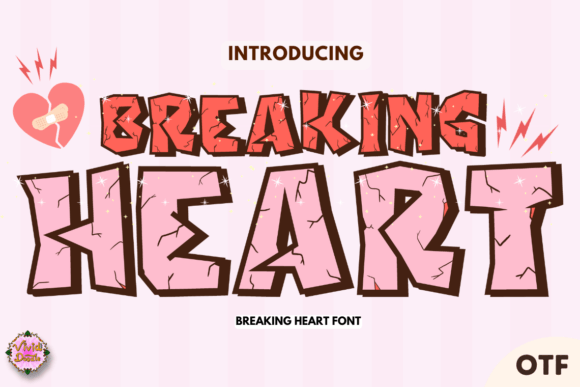
Breaking Heart: A Handwritten Display Font for Your Brand
When you run a small business, every visual choice you make sends a message to your customers. The fonts you select are part of that conversation. Breaking Heart is a handwritten display font designed to bring warmth and emotion into your brand materials. Inspired by love and crafted for real-world business use, this typeface helps you create titles, greeting cards, lettering, banners, and more with a personal touch that connects with your audience. For entrepreneurs and independent creators, Breaking Heart offers a way to make your brand feel human without sacrificing professionalism.
Breaking Heart for Greeting Cards and Emotional Branding
Breaking Heart shines in projects where emotion drives the message. As a handwritten display font, it carries an authentic, hand-drawn quality that feels personal and sincere. If you sell greeting cards, thank-you notes, or seasonal stationery, this typeface helps you express sentiment without needing custom lettering for every design. The irregular strokes and natural flow of Breaking Heart mimic real handwriting, which makes your products feel less manufactured and more like something a person took time to create. For small businesses in the paper goods space, that emotional quality builds trust and encourages repeat purchases.
Beyond greeting cards, you can use Breaking Heart in banner designs for special promotions, event announcements, or limited-edition product drops. The font's expressive character draws attention without overwhelming the layout. When you place a short, heartfelt message in Breaking Heart on a banner or flyer, customers pause and read it. That moment of connection can turn a casual browser into a buyer.
Using Breaking Heart in Logo Design and Business Identity
A logo needs to be memorable, and Breaking Heart delivers a distinct look that customers recognize. As a handwritten display font, it works well for boutique brands, bakeries, beauty product lines, and coaching businesses where personality matters. If your brand name is short—one or two words—setting it in Breaking Heart creates a logo that feels intimate and approachable. For example, a handmade soap company called "Wild Bloom" could use Breaking Heart for the wordmark, pairing it with a subtle icon or border. The font's rounded, gentle letterforms communicate care and craftsmanship, which aligns perfectly with handcrafted products.
When building your broader business identity, use Breaking Heart as your primary logo typeface while keeping supporting materials clean and simple. The contrast between an expressive logo and minimal packaging or website design helps your brand stand out. Consistency across business cards, letterhead, and email signatures further reinforces your identity. A cohesive look tells customers you are serious about quality, even if you are a solo entrepreneur working from home.
Breaking Heart on Product Labels and Packaging Design
Product labels are often the first physical touchpoint a customer has with your brand. Breaking Heart works beautifully on labels for candles, jams, teas, skincare products, and gift sets. Because it is a handwritten display font, it adds a personal, artisanal feel to packaging that might otherwise look generic. Imagine a lavender candle with a small label featuring the scent name in Breaking Heart and a brief tagline underneath. The font's emotional quality makes the product feel like a thoughtful gift, even if the customer is buying it for themselves.
For small-batch food products, such as homemade granola or honey, Breaking Heart can communicate the care that goes into each batch. When shoppers see a handwritten-style font on a label, they subconsciously associate it with small-scale production and attention to detail. That perception is valuable for small businesses competing against mass-market brands. Just ensure the font size is large enough to read on small jars or tubes. Test a print sample at actual size before committing to a full production run. On tiny labels, you may need to use Breaking Heart only for the brand name or a key phrase, with cleaner text for ingredients or instructions.
Breaking Heart for Social Media Graphics and Digital Ads
Social media moves fast, and your graphics need to stop the scroll. Breaking Heart helps you create Instagram posts, Pinterest pins, and Facebook ads that feel human and relatable. As a display font, it is best used for short headlines, quotes, or calls to action rather than long captions. A post featuring a quote set in Breaking Heart against a soft background can generate engagement because the typography itself carries emotional weight. Small business owners often struggle to make their social content feel authentic; using a handwritten typeface like Breaking Heart is a simple way to add that warmth.
On Pinterest, where users search for inspiration and ideas, Breaking Heart works well on pins for wedding planning, gift guides, home decor, and self-care routines. Pair the font with high-quality lifestyle photography to create pins that attract clicks. For digital ads, keep the text minimal—a product name or a short benefit statement in Breaking Heart—and let the visual do the rest. Because the font has a strong personality, it holds its own even at smaller sizes on mobile screens. Test your ad preview on both desktop and mobile to confirm readability.
Pairing Breaking Heart with a Clean Sans Serif Font
Using one font across all your materials can feel monotonous, and a purely decorative typeface may tire the eye over time. The smart approach is to pair Breaking Heart with a clean, neutral sans serif font. The contrast between an expressive handwritten display typeface and a simple, modern sans serif creates visual hierarchy and improves readability. For example, use Breaking Heart for your main headline or product name, and set body text, descriptions, or contact details in a sans serif companion.
Good pairings for Breaking Heart include lightweight or regular-weight sans serif options like Open Sans, Lato, or Montserrat. These fonts stay out of the way while letting Breaking Heart take center stage. You can also experiment with a subtle serif font for a more classic or editorial feel, but generally, a sans serif keeps the look fresh and approachable. When pairing, avoid using two decorative or script fonts together; they compete for attention and confuse the reader. Let Breaking Heart be the star and keep everything else simple.
When to Use Breaking Heart as a Headline or Display Font
Breaking Heart is a display font, which means it is designed for larger sizes and shorter text. Use it when you want to create impact: in headlines, logos, product names, pull quotes, and section titles. Avoid using it for long paragraphs, dense product descriptions, or small legal text. The handwritten style that makes Breaking Heart so charming in a headline becomes tiring to read in a block of text. Reserve it for moments where you need emotion and emphasis.
On your website, consider using Breaking Heart for hero section headlines, call-to-action buttons, or testimonial quotes. On printed menus, set the category headers in Breaking Heart and list the items in a clean sans serif. In email marketing, use the font sparingly in the subject line preview or opening greeting. The goal is to use Breaking Heart as an accent that adds warmth without sacrificing clarity. When customers see your materials, they should feel the emotion without struggling to read the words.
Testing Breaking Heart Across Different Business Materials
Before committing Breaking Heart to your entire brand, test it on real materials. Print a business card, a product label, and a small poster at actual size. Hold them in your hand and see how the font reads from a normal viewing distance. Show them to a friend or a trusted customer and ask for honest feedback. Sometimes a font that looks beautiful on screen feels different in print, especially at small sizes. Breaking Heart has a natural, uneven rhythm that adds character, but you want to confirm that key information remains legible.
Test your digital materials too. Create a mockup of an Instagram post, a website banner, and an email header. View them on a phone, a tablet, and a laptop. Because Breaking Heart is a display font, it performs best when given enough space. If you find yourself squeezing the letters or reducing the size to fit more text, consider using the font only for the most prominent element and letting a simpler font carry the rest. Testing early saves you from printing hundreds of labels or publishing dozens of social posts before realizing an adjustment is needed.
Licensing Breaking Heart for Commercial Projects
Before you use Breaking Heart on products, packaging, templates, merchandise, client work, or digital downloads, check the commercial licensing terms. Many premium fonts require an extended license for specific uses like selling products with the font on the packaging or using it in logo designs for paying clients. As a small business owner, you want to avoid legal issues down the road. Review the license agreement that comes with Breaking Heart and confirm it covers your intended use. If you plan to sell physical goods with the font embossed, printed, or engraved on them, look for a license that explicitly allows that. Investing in the correct license protects your business and respects the type designer's work.
Some font foundries offer tiered licensing, so you may pay more for broader commercial use. Budget for this expense when planning your brand assets. Using an unlicensed font on your storefront or packaging can lead to takedown notices or fines, which are far more costly than the license itself. If you are unsure, contact the foundry directly. Most are happy to clarify what is allowed. Once you have the proper license, you can confidently use Breaking Heart across all your customer-facing materials, knowing your brand is built on a solid legal foundation.
For entrepreneurs who sell on platforms like Etsy, Amazon, or their own website, commercial licensing is especially important. If you create digital products such as templates, planners, or printables that include Breaking Heart, make sure your license covers redistribution or embedding. When you respect the licensing terms, you support the designers who create the tools your business relies on, and you set an example of professional integrity for your customers.
Ultimately, Breaking Heart is more than a pretty typeface. It is a practical tool that helps small business owners communicate warmth, care, and authenticity. Used thoughtfully, this handwritten display font can elevate your brand identity, strengthen customer trust, and make your materials stand out in a crowded market. Whether you are designing greeting cards, product labels, social media graphics, or a full brand identity, Breaking Heart gives you a distinctive voice that feels both personal and professional. Take the time to test it, pair it wisely, and license it correctly, and this font will serve your business well for years to come.